Thursday, 14 July 2011

LANG PIONEER VILLAGE MUSEUM


LANG PIONEER VILLAGE - KEENEE, ONTARIO


Lang Pioneer Village Museum was established by the County of Peterborough in 1967 to celebrate and preserve the rural history of the area.


Milbourn House - restaured to 1870's


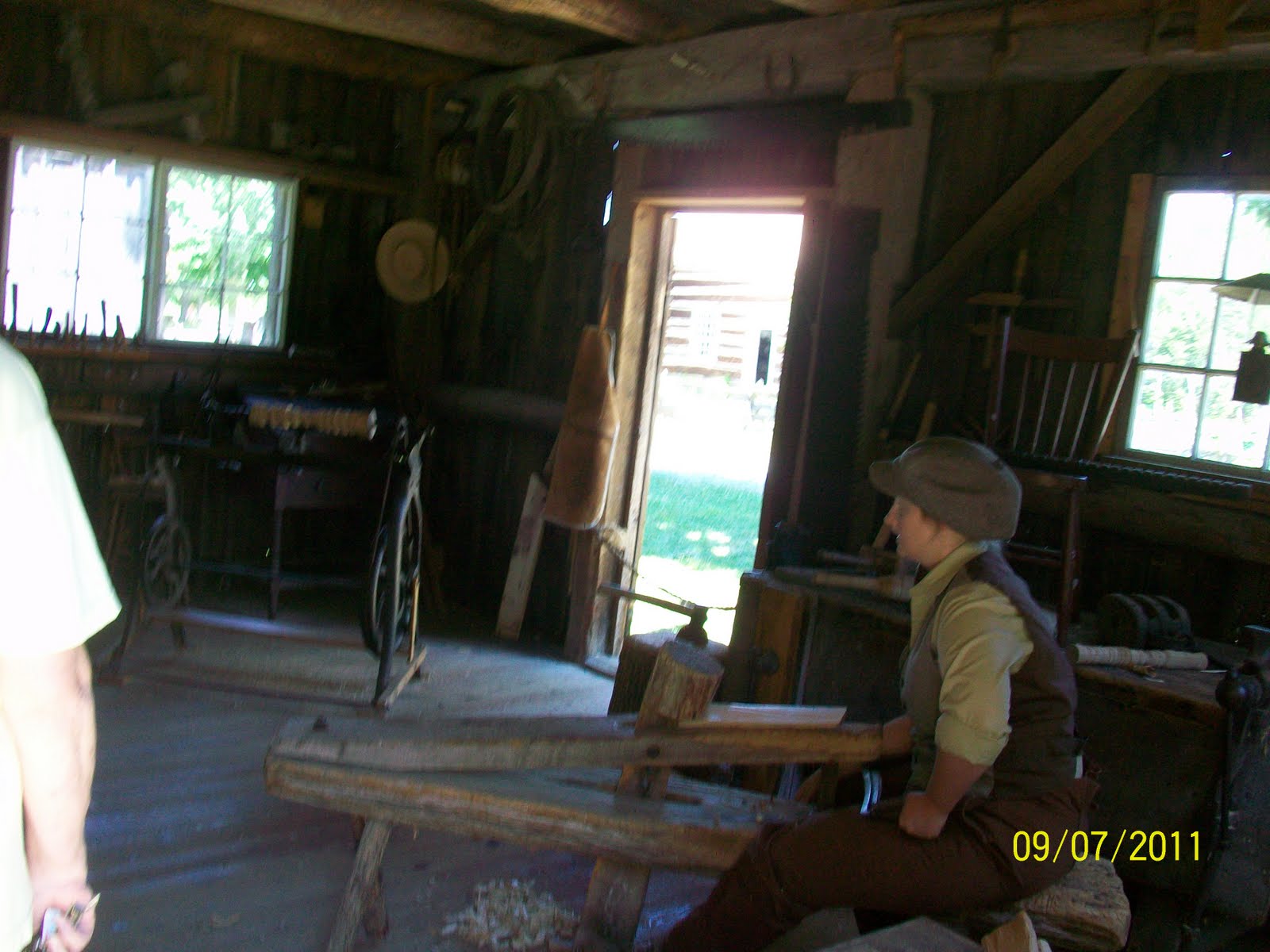
Hastie Carpenter Shop


Tinsmith Shop
Fitzpatrick House, restaured to the 1840's


Fife Cabin - settler's first home, restaured to 1820's

Register Print Shop - with original equipent from the "Norwood Register"


Keene Hotel - 1870's accomodations


(25cents room)
This tin bathtub would be filled by hand. A person would sit on the wide rim of the tub to bathe

Ash House - stored ashes to make soap

Menie General Store (and Post Office)


Blacksmith Shop


This watering trough was originally owned by Campbell’s Dairy in Peterborough. It provided a stop for the milk wagon horses to obtain a drink before proceeding on with their routes
Glen Alda Methodist Church (1898)


Douro Town Hall - restaured to 1897


South Lake School - A 1-room for grades 1 - 8

Cheese Factory
Cider Barn


Smoke house - used to smoke meat

Ice House - ice stored in sawdust - served as a refrigerator


Agriculture barn


This stump/stone puller was build in the early 1850's was used to remove large stones
Laundry

(A few of 322 pictures)

Tuesday, 12 July 2011

July 12, 1982 - IN MEMORY OF MY ANGEL - CHRISTINA

IN MEMORY OF AN ANGEL
CHRISTINA CARDOSO
JULY 12, 1982 – 29 YEARS AGO!
NEVER GOT A CHANCE ON EARTH.


A baby changes lives. It doesn’t matter if that small person has never drawn breath, or has lived only a short time, for the people who are left, things are never the same again.

The death of a baby is a loss of a person and the loss of future dreams.


Death leaves a heartache no one can heal, love leaves a memory no one can steal.
~
From a headstone in Ireland

"None of us can help the things life has done to us.
They're done before you realize it"


- Footprints on the Heart -


Some people come into our lives

and quickly go.

Some people move our souls to dance.
They awaken us

to new understanding
with the passing whisper of their wisdom.


Some people make

the sky more beautiful to gaze upon.

They stay in our lives for awhile,

leave footprints on our hearts

And we are never, ever the same


Even if happiness forgets you a little bit, never completely forget about it.
~Jacques Prévert

I wonder what it would be like
I wonder how it would be
But life has no rewind button

-So I wish you a Happy Birthday,
A birthday of your rebirth,
As you sit at the foot of God,
Ensuring my peace on earth.
' See you when I get there’!
Historic Cataraqui Cemetery
What is life?
Life is a gift, accept it.
Life is an adventure, dare it.
Life is a mystery, unfold it.
Life is a game, play it.
Life is a struggle, face it.
Life is beauty, praise it.
Life is a puzzle, solve it.
Life is opportunity, take it.
Life is sorrowful, experience it.
Life is a song, sing it.
Life is a goal, achieve it.
Life is a mission, fulfill it.
(Author unknown)

Wednesday, 6 July 2011

HAPPY 235th INDEPENDENCE DAY to U.S.A.


Independence Day, commonly known as the Fourth of July, is a federal holiday in the United States commemorating the adoption of the Declaration of Independence on July 4, 1776, declaring independence from the Kingdom of Great Britain. Independence Day is commonly associated with fireworks, parades, barbecues, carnivals, fairs, picnics, concerts, baseball games, family reunions, political speeches and ceremonies, in addition to various other public and private events celebrating the history, government, and traditions of the United States. Independence Day is the national day of the United States. (wikipedia.org)

Our neighbours celebrated 235 years of British Independence, so I feel that should write a litle about the event and less unknown people that made a difference and inspire us.

We all know GEORGE WASHINGTON was the 1st. President of U.S.A, but we should know about his remarkable wife, MARTHA, a person that didn't let her not so pleasant life,  shadow her positive side of life.

Martha Dandridge Custis Washington (June 2, 1731 – May 22, 1802) was the wife of George Washington, the first president of the United States. Although the title was not coined until after her death, Martha Washington is considered to be the first First Lady of the United States. During her lifetime, she was known as "Lady Washington". (wikipedia.org)


 “I have learned that the greater part of our misery or unhappiness is determined not by our circumstance but by our disposition.” - Martha Washington


Pretty powerful words from a wealthy woman, who ended up being the FIRST, First Lady. What disappointments could she have possibly had going on in HER life to overcome. Sometimes we see quotes like the one above, and eventhough the message is great, and we “get it”, we can think to ourselves, that “things were different back then, they didn’t have the same stress we do today.” See if you would want to trade places with her:

1. She had 4 children.

2. Her son, Daniel, died at the age of 3.

3. Her daughter, Frances, died when he was 4.

4. Her first husband, Daniel Custis, died that same year.

5. Her oldest daughter, Martha, died from a siezure at age 18.

6. Her son, John, died during military service as a young adult.

Puts a new light on choosing to be happy, doesn’t it?

Yes, it takes a conscious effort to CHOOSE to be happy, grateful, and content.

 
In 1902, Martha Washington became the first American woman to be honored on a U.S. postage stamp.


Out of curiosity, added to the Martha Washington bigraphy:

In the book The Intimate Lives of the Founding Fathers by Thomas Fleming, the author addresses the issue of Martha’s wealth when George married her on January 6, 1759. He notes that Martha’s first husband, Daniel Parke Custis, had died without a will. He estimates the value of their 17,438-acre estate at some three million dollars in today’s money.

Because Martha’s first husband died without a will, Martha was granted a dower share – the lifetime use of one-third of the estate’s assets. This share would be held in trust for her children. The slaves working the estate were also subject to a dower-determined distribution. [From 1705 until 1792, Virginia defined slaves as real property. This is because if the slaves did not remain with the land to work it, the value of the land was diminished. See Donn Devine, "The Widow’s Dower Interest," in Ancestry Magazine, Vol. 12, no. 5, 1 Sep 1994.)] Martha received approximately 85 slaves as part of the dower share of the Custis estate.
When Martha remarried, another principle of law came into effect: coverture, which defined the legal status of woman following marriage. Under the doctrine of coverture, the husband and wife became a single unit for property purposes, with the husband having complete control over all the property of either person. All property a woman brought into marriage, including real estate, clothing, furniture, or money, became the property of her husband. (See Dorothy A. Mays, Women in Early America: Struggle, Survival, and Freedom in a New World, Calif.: 2004, p. 91.) However, the wife’s interest in dower real estate was limited to a life estate, not a fee simple interest. Accordingly, a husband could not sell dower real estate (including slaves), without his wife’s consent.
Thus Washington could control Martha’s dower wealth, but he didn’t actually own it (in fee simple) and could not sell it. Martha’s one-third was “his” property only for the duration of Martha’s life.
(http://legallegacy.wordpress.com/)


Friday, 1 July 2011

UNIQUELY CARS OF THE WORLD … MADE IN CANADA


Uniquely Canadian cars
Cars for the world … made in Canada


A car that's uniquely Canadian isn't as difficult to find as you might imagine - and we're not talking about badge wonders like the Acura CSX either. No, we're talking designed, engineered and built for a global audience right here in Canada. None could really be considered every-day transportation, but all have definite elements of fun and raw performance. Click through to see what we've assembled.

De Macross GT1
De Macross GT1 (Photo: De Macross)
Photo: De Macross

Utilizing the assembled brain-trust at Markham, Ont.-based Multimatic, the De Macross GT1 could very well be the ultimate supercar. Using suspension technology borrowed from Formula One, a carbon fibre tub, and a Roush-tuned 5.4-litre V8 that uses a supercharger to help boost horsepower to 800 and torque to 700 lb.-ft. DeMacross claims that it'll hit 100 km/h in 3.5 seconds before topping out close to 350 km/h. The styling borrows bits and hits from a broad cross-section of performance cars, like the Ferrari F50, Ford GT, maybe a hint of Ferrari here and there. Price? Try a million and a half loonies.

Campagna T-Rex
Campagna T-Rex (Photo: Campagna)
With a name like Campagna, you'd expect a fire-breathing V12 exotic from Italy, not a low, lithe 'trike' from Montreal. But its T-Rex has lasted 15 years broadly unchanged. Things like more power, suspension refinements and wheel designs have evolved in that time, but Canadian Paul Deutschman's raw little design still turns heads. The current top-level 14RR uses a Kawasaki-sourced 1400cc engine that produces 197 horsepower and 113 lb.-ft. of torque. Power goes to the single wide rear tire through a six-speed sequential gearbox. Performance for you and one passenger is mind-blowing for only $58,500.

Campagna V13R
Campagna V13R (Photo: Campagna)
Like its T-Rex sibling, the Campagna V13R is a three-wheel 'car' that sits two people side by side, with the engine, transmission and single rear wheel behind. But unlike the futuristic T-Rex, the V13R is more traditional, more sculpted, more muscular, and it doesn't have a top. The Harley-Davidson-sourced V-Twin provides 122 horsepower and 84 lb.-ft. of torque and uses a five-speed sequential transmission. More relaxed tourer than outright corner carver, there's even space in the front trunk for some small squishable suitcases. Much more accessible too, starting at $47,999.
HTT Pléthore LC-750
HTT Pléthore LC-750 (Photo: HTT Technologies)
Photo: HTT Technologies

Another Montreal-based entry comes from HTT and its Pléthore LC-750 supercar. There's nothing subtle about its three-abreast seating, six-speed sequential racing transmission or 750-horsepower supercharged 7.0-litre V8. The chassis and body are made of carbon fibre, meaning the weight is kept reasonable at only 1,100 kg. A Canadian take on the McLaren F1? Awful close, and in these times of million-dollar Lamborghinis and Aston Martins, the $795,000 that HTT want for a Pléthore seems almost reasonable.

Bricklin SV-1
Bricklin SV-1 (Photo: Bricklin)
Photo: Bricklin

This one doesn't quite follow the pattern of the previous entries, as it's the only car on this list not currently in - or slated for - production, but despite being developed and built in the mid-'70s, the Bricklin SV-1 still looks remarkably modern. Assembled in New Brunswick, the gullwing-doored SV-1 was built of fibreglass with an integrated roll cage and came in one of five easy-to-spot colours. Although they were powered by either AMC or Ford V8's, power numbers were never terribly impressive, but some of the American magazines felt the SV-1 was a match for its Corvette contemporary. High praise indeed.

Can-Am Spyder
Can-Am Spyder (Photo: BRP)
Photo: BRP

Another Canadian trike built near Montreal, the Can-Am Spyder features more conventional motorcycle-style seating, but with two front wheels sharing the steering duties. That its layout and controls are similar to a snowmobile shouldn't come as a surprise since BRP - owner of Can-Am - also produces Ski-Doos. Fitted with modern safety systems, like ABS and traction control, the Spyder draws a crowd. And it can escape pretty easily too thanks to its 106-horsepower Rotax 990 V-Twin engine. Pricey at just under $20,000 to start, but very unique.

Can-Am Roadster
Can-Am Roadster (Photo: BRP)
Photo: BRP

The Roadster shares most of its parts with the previously mentioned Spyder, but adds a larger front fairing, an electrically operated windshield, and a larger passenger seat and moulded seat bags. More designed for cruising with friends or long-distance trips to Florida. There's GPS, a standard semi-auto transmission, cruise control, embroidered seats ... the Cadillac of Can-Ams starts at $24,899.

Allard J2X
Allard J2X (Photo: Allard)
Photo: Allard

Unlike the Bricklin, the Allard J2X is simply the continuation of a great line of Allard cars originally built in the early '50s. Considered by many to be one of the first factory hot-rods, the J2X featured a lightweight body, pretty simple suspension and gigantic Cadillac or Chrysler Hemi V8s for the requisite shove. The MKII that the Montreal-based Allard Motor Works now sells to the public is nearly identical in every respect, but subtly updated for better comfort, safety and performance. The V8 is a 350-hp GM unit (a 5.7-litre or 6.1-litre Chrysler Hemi is also available) with a five-speed manual transmission. Even the 'base' J2X will hit 100 km/h in the high four second range. Priced from $140,000.

Motive Kestrel
Motive Kestrel (Photo: Motive)
Photo: Motive

Given that Canadians are a particularly practical-minded and frugal bunch, it's been something of a surprise to see that all the vehicles on our list are performance-first fun-machines. But here's one that breaks that trend - the Motive Kestrel, a four-seat compact electric car that hails from Calgary, Alta. This tailpipe emissions-free ride has a range of 160 km per charge, and can travel at speeds of up to 135 km/h. Expect to see it on the market sometime next year.
By Mark Atkinson for MSN Autos


Canadian Auto Manufacturers
OTHER CARS MADE IN CANADA
Manufacturer Model Notes
AcuraCSX Sedan
MDX
Sport Utility
Japanese company. Manufactured in Alliston Ontario.
Chrysler Chrysler Town & Country
Dodge Caravan
American company. Manufactured in Windsor Ontario
Chrysler 300 seriesDodge Charger
Dodge Challenger
American company. Manufactured in Brampton Ontario
Ford Crown VictoriaMercury Grand Marquis American company. Manufactured in St Thomas Ontario
Edge
Lincoln MKX
Flex
American company. Manufactured in Oakville Ontario
General MotorsChevrolet CamaroChevrolet Impala
Buick Allure
Buick LaCrosse
American company. Manufactured in Oshawa Ontario
Chevrolet EquinoxPontiac Torrent
GMC Terrain
Manufactured in Ingersoll Ontario.
Joint venture with Suzuki
Diesel Locomotives
Light Armored Vehicles
Manufactured in London Ontario
Honda Civic Sedan, Si and Coupe
Odyssey
Ridgeline
Japanese company. Manufactured in Alliston Ontario.
Kenworth T300 Medium Duty Truck American company. Manufactured in St-Therese Quebec
Suzuki XL7 Japanese company. Manufactured in Ingersoll Ontario. Joint venture with General Motors.
Toyota Corolla
Lexus RX350
Matrix
Japanese company. Manufactured in Cambridge Ontario.
Rav4 Japanese company. Manufactured in Woodstock Ontario
Volkswagen Routan Germany company contracting with Chrysler to manufacture the Routan in their Windsor Ontario plant
Zenn Zenn Canadian company manufacturers an electric car in St. Jerome Quebec

CANADA'S BEST RECIPES (or some of them)

Canada's Best: Recipes from Coast to Coast

Take a culinary tour through the provinces, from Ontario's strawberries to Quebec's artisanal cheese to Manitoba's bison. Now you can savour all the best local ingredients at home with recipes from some of Canada's most renowned chefs.


Ontario: Strawberries

The only thing that makes coming back from a cottage weekend in early summer bearable is stopping at one of the roadside wild strawberry stands. Though you can get imported strawberries year-round, none match the sweet, lively taste of fresh Ontario strawberries, available from mid-June to July. Tiny in size compared to imported varieties, they pack some huge flavour.

British Columbia: Spot Prawns
The largest of the shrimp varieties found in Western Canada's waters, B.C. spot prawns are beloved for their sweet, delicate flavour and firm-yet-tender texture — and appreciated all the more for their scarcity. The spot prawn harvest season starts in May and lasts just 80 days, though frozen prawns are available year-round — so catch 'em while you can.
 
Saskatchewan: Saskatoon Berries
Saskatoon berries, or prairie berries, aren't actually berries at all; they're pomes, a fruit related to apples. Originally eaten by Native peoples and early Prairie settlers, these "berries" have recently become popular for their high antioxidant count — they beat out strawberries, wild blueberries, and many other common fruits. Try them in typical berry dishes, from muffins and pies to jams and glazes.

Alberta: Beef
With nearly seven million head of cattle, Alberta is Canada's largest beef supplier. And Alberta beef is known for its tenderness, flavour, juiciness, and texture. It's so good, it's even imported to Japan, land of the famed Kobe beef. Try it prepared simply, as in this recipe from Chef John Jackson of Calgary's CHARCUT Roast House, and let the meat speak for itself.

Yukon: Birch Syrup


Maple syrup is arguably one of Canada's best-known food exports, but in the Yukon, they harvest birch sap to create a uniquely northern product. In her book The Boreal Gourmet: Adventures in Northern Cooking, author Michele Genest recommends treating the birch variety as a savoury way to enhance dressings or marinades.
Quebec: Artisanal Cheeses

Move over, France. Quebec is making a name for itself for its high-quality artisanal cheeses and impressive variety of cow's, goat's, and sheep's milk cheeses — including fragrant, unripened, and blue varieties — made according to traditional French techniques. Quebec cheesemakers are even allowed to sell tasty raw-milk cheeses illegal elsewhere because of health fears associated with eating unpasteurized products. Risky? Perhaps. Tasty? We say, "Cheese, please!"
 
Nova Scotia: Beer

All Canadians love their beer, and Nova Scotia is a famous beer destination, thanks to one of North America's oldest breweries: Alexander Keith's Brewery, founded in 1820. But Nova Scotia's beer scene doesn't begin and end with Keith's. Halifax is home to a number of brewpubs and microbreweries, making the province a top destination for lager and ale fans.
Newfoundland: Cod
 
With fisheries dating back to the 16th century, it's not surprising that cod features prominently on The Rock. In fact, if a menu lists fish, it's safe to assume that fish is cod. Newfoundlanders are adventurous enough to dip into dishes like cod cheeks and tongues. But if that's not for you, don't worry: You'll also find more traditional dishes such as pan-fried cod and, of course, good ol' fish and chips.
Manitoba: Bison
 
Lower in fat and calories than beef, bison is winning over red-meat fans for its lean, flavourful cuts. Historically a staple for First Nations and Prairie settlers alike, bison were nearly extinct in the 19th century. But thanks to Manitoba's climate and vast pastures, they have made a comeback and can increasingly be found on menus in traditional beef dishes. Try bison for everything from steak to burgers.

New Brunswick: Fiddleheads
 
The village of Tide Head, New Brunswick, boldly calls itself the Fiddlehead Capital of the World, though they are available elsewhere. In season in the springtime, fiddleheads are wild green ferns that are typically served cooked. Try boiling them until slightly tender and serving sprinkled with sea salt and a dash of butter or drizzle of olive oil.
 

HAPPY 144th BIRTHDAY

HAPPY 144th BIRTHDAY

Official Lyrics of O Canada!

O Canada!
Our home and native land!
True patriot love in all thy sons command.
With glowing hearts we see thee rise,
The True North strong and free!
From far and wide,
O Canada, we stand on guard for thee.
God keep our land glorious and free!
O Canada, we stand on guard for thee.
How Canada Got Its Name

The Origin of the Name Canada
Imaginary Portrait of Jacques Cartier
 Imaginary Portrait of Jacques Cartier
The origin of the name "Canada" comes from the expedition of explorer Jacques Cartier up the St. Lawrence River in 1535. The Iroquois pointing out the route to the village of Stadacona, the future site of Quebec City, used the word "kanata," the Huron-Iroquois word for village. Jacques Cartier used the word Canada to refer to both the settlement of Stadacona and the land surrounding it subject to Chief Donnacona.
By 1547, maps were showing the name Canada applied to everything north of the St. Lawrence River. The St. Lawrence River was called the "rivière du Canada" by Cartier, and the name stuck until the 1600s.
In the 1600s, the name Canada was often used loosely to refer to New France, and as land opened up to the west and south in the 1700s, the name Canada was applied to what is now the American midwest and as far south as present day Louisiana. But it was not official.
In 1791, the Constitutional Act or Canada Act divided the Province of Quebec into two - the colonies of Upper Canada and Lower Canada. In 1841, the two colonies were united again, this time as the Province of Canada.
At Confederation in 1867, the British North America Act officially joined the Province of Canada (Quebec and Ontario) with Nova Scotia and New Brunswick to become "one Dominion under the name of Canada."
Canada wasn't the only name considered for the new dominion though. Other names suggested at the time of Confederation were:
  • Victorialand
  • Borealia
  • Cabotia
  • Tuponia (The United Provinces of North America)
  • Superior
  • Norland
  • Hochelaga
  

Fathers of Confederation - Canada

Men Who Negotiated Canadian Confederation

Fathers of Confederation

 Canadian Fathers of Conferation are usually considered to be the 36 men representing the British colonies in North Ameria who attended at least one of the three major conferences on Canadian confederation - the Charlottetown Conference in 1864, the Quebec Conference in 1864 and the London Conference in 1866-67.

The British colonies represented were:

  • Nova Scotia
  • New Brunswick
  • Prince Edward Island
  • Newfoundland
  • Province of Canada (later Ontario and Quebec)

Fathers of Confederation

  • Adams Archibald (Nova Scotia)
  • George Brown (Canada)
  • Alexander Campbell (Canada)
  • F B T Carter (Newfoundland)
  • George-Etienne Cartier (Canada)
  • Edward Barron Chandler (New Brunswick)
  • J C Chapais (Canada)
  • James Cockburn (Canada)
  • George Coles (PEI)
  • Robert Dickey (Nova Scotia)
  • Charles Fisher (New Brunswick)
  • Alexander Galt (Canada)
  • John Hamilton Gray (New Brunswick)
  • John Hamilton Gray (PEI)
  • T H Haviland (PEI)
  • William Henry (Nova Scotia)
  • W P Howland (Canada)
Entry Into Canadian Confederation

Dates Provinces and Territories Entered Canadian Confederation


Province / Territory
Date Entered Confederation
September 1, 1905
July 20, 1871
July 15, 1870
July 1, 1867
March 31, 1949
July 15, 1870
July 1, 1867
April 1, 1999
July 1, 1867
July 1, 1873
July 1, 1867
September 1, 1905
June 13, 1898

Prime Minister Sir John A. Macdonald 
 1867-73, 1878-91
 Sir John A. Macdonald, Prime Minister of Canada
Sir John A. Macdonald, Prime Minister of Canada

Birth: January 10, 1815 in Glasgow, Scotland. Came to Canada in 1820.

Death:June 6, 1891 in Ottawa, Ontario


Sir John A. Macdonald was a Father of Confederation and drafted two-thirds of the provisions of the British North America Act. Sir John A. Macdonald was the first Prime Minister of Canada,

  • building a trans-continental railway, the Canadian Pacific Railway

  • building a nation with the entry into Confederation of Prince Edward Island, the Northwest Territories (including Alberta and Saskatchewan), Manitoba, and British Columbia

  • opening the West for settlement

  • creation of the North-West Mounted Police

  • the Northwest Rebellion and the hanging of Louis Riel

  • the National Policy of tariffs against imports to protect Canadian industry


  • 
    The National Flag of Canada
    Canadian Flag Flying on Parliament Hill
    Canadian Flag Flying on Parliament Hill

    History, Symbolism & Rules for Flying the National Flag

    The Canadian red and white maple leaf flag is officially called The National Flag of Canada. The Canadian flag shows a stylized red maple leaf with 11 points on a white background, with red borders down each side. The Canadian flag is twice as long as it is wide. The white square containing the red maple leaf is the same width as the flag.
    The red and white used in the National Flag of Canada were proclaimed the official colours of Canada in 1921 by King George V. Although the maple leaf did not have official status as an emblem of Canada until the proclamation of the national flag in 1965, it had historically been used as a Canadian symbol, and was used in 1860 in decorations for the visit of the Prince of Wales to Canada. The 11 points on the maple leaf have no special significance.

    A Flag for Canada

    It wasn't until the 1965 inauguration of the maple leaf flag that Canada had its own national flag. In the early days of Canadian Confederation the Royal Union flag, or Union Jack, was still flown in British North America. The Red Ensign, with a Union Jack in the upper left corner and a shield containing the coats of arms of the Canadian provinces, was used as the unofficial flag of Canada from about 1870 to 1924. The composite shield was then replaced with the Royal Arms of Canada and approved for use overseas. In 1945 it was authorized for general use.
    In 1925 and again in 1946, Canadian Prime Minister Mackenzie King tried to get a national flag of Canada adopted, and failed. In 1964, Prime Minister Lester Pearson appointed a 15-member, all-party committee to come up with the design of a new flag for Canada. The committee was given six weeks to complete its task.
    The suggestion for a red and white single maple leaf design for the Canadian flag came from George Stanley, a professor at Royal Military College in Kingston, Ontario.
    In his speech at the national flag inauguration ceremony, Prime Minister Lester Pearson said:
    "Under this Flag may our youth find new inspiration for loyalty to Canada; for a patriotism based not on any mean or narrow nationalism, but on the deep and equal pride that all Canadians will feel for every part of this good land."

    Dignity of the Canadian Flag

    Flag Etiquette in Canada on the Canadian Heritage Department site provides the rules for flying and displaying the Canadian flag in different situations - affixed to a car or carried in a procession, for example.
    Fundamental to these rules is the principle that The National Flag of Canada should always be treated with dignity and that it takes precedence over all other national flags and ensigns when flown in Canada.

    The History of the National Anthem

    (Summary)


    Musical note"O Canada" was proclaimed Canada's national anthem on July 1, 1980, 100 years after it was first sung on June 24, 1880. The music was composed by Calixa Lavallée, a well-known composer; French lyrics to accompany the music were written by Sir Adolphe-Basile Routhier. The song gained steadily in popularity. Many English versions have appeared over the years. The version on which the official English lyrics are based was written in 1908 by Mr. Justice Robert Stanley Weir. The official English version includes changes recommended in 1968 by a Special Joint Committee of the Senate and House of Commons. The French lyrics remain unaltered.

    Musical noteÔ Canada! 


    « O Canada! Terre de nos aïeux,
    Ton front est ceint de fleurons glorieux!
    Car ton bras sait porter l'épée,
    Il sait porter la croix!
    Ton histoire est une épopée
    Des plus brillants exploits.
    Et ta valeur, de foi trempée,
    Protégera nos foyers et nos droits.
    Protégera nos foyers et nos droits. »

    www.pch.gc.ca   for a full story of "O Canada"

    Etiquette during the playing of the national anthem

    As a matter of respect and tradition, it is proper to stand for the playing of "O Canada" as well as for the anthem of any other nation.
    It is traditional for civilian men to take off their hats during the playing of the national anthem. Women as well as children do not remove their hats on such occasions.
    There is no law or behaviour governing the playing of the national anthem; it is left to the good citizenship of individuals.


      HAPPY 144th BIRTHDAY


    Canada day toronto live